Showing posts with label documentary. Show all posts

Monday, September 19, 2022

Brett Morgen's 'Moonage Daydream' Captures Bowie in all his Colourful Complexity


Brett Morgen's Moonage Daydream documentary
Brett Morgen's impressionistic documentary on rock legend David Bowie hits its' mark, capturing a complex human and diving deep into what motivated him.

"Never play to the gallery (laughs). But you never learn that until much later on, I think... I think it's terribly dangerous for an Artist to fulfill other people's expectations. I think they generally produce their worst work when they do that. The other thing I would say is that if you feel safe in the area you're working in, you're not working in the right area. Always go a little further into the water than you feel you're capable of being in. Go a little bit out of your depth. And when you don't feel that your feet are quite touching the bottom, you're just about at the right place to do something exciting." - David Bowie interview from the 1990s'

Director Brett Morgen's Moonage Daydream Paints David Bowie in broad strokes while revealing a warm, humane philosophy of life

Moonage Daydream, a film collage exploration of David Bowie's career, begins with cold space. Specifically the surface of the Moon and a crumpled, empty Astronaut's uniform with a smiley face on the chest plate. As this image fades out, there is a fade-in of Hallo Spaceboy. And just like that, we're plunged into the action.

Director Brett Morgen assumes his viewers are familiar with Bowie's signature achievements and outsize impact on popular culture. So in making the film, which has a rubber stamp from the Thin White Duke's estate, he goes for a splashy neon collage of a movie that explores major themes in the man's life and body of work. 

Narrated mostly by Bowie himself, Moonage Daydream covers well-known events in Bowie's life from approximately 1971 (Ziggy Stardust and the Spiders from Mars) through the early 1980s' (Let's Dance). His last album, 2016's Blackstar, and Bowie's death shortly after the album's release is barely touched on. 

Which is a good thing, in my opinion. By allowing Bowie to narrate the bulk of the picture his philosophy of life is explored - both the light and the dark. Alienation and Isolation - well-known Bowie themes - are covered here in his emotionally distant relationship with his parents. His family suffered from, "an awful lot of emotional-spiritual mutilation," in the Artist's words.

We also get to see him offer his own version of spirituality. There are surprisingly warm reflections about the importance of travel, being connected to other human beings, and the pure joy of a life filled with a large variety of experiences. 

I particularly identify with his desire to make every day count. The man hated wasting time. When answering a 'Proust Questionnaire' in 1998, to answer the question: "What do you consider to be your greatest achievement?," Bowie responded: "To have discovered the early morning." That time of day when it feels as if the world belongs to you, and you alone. 

Though I am familiar with his work, and own all of Bowie's albums, I was still surprised by the intellectual playfulness and flexibility he displayed. It's well articulated in the audio and video clips Morgen chose to use.

While overall an excellent ride, I do have two criticisms of Moonage Daydream. Firstly, the lack of context and chronological progression could be off putting for viewers who are not well versed in David Bowie's work and personas. (There was a lot of work - in addition to the albums, Bowie painted, acted on stage and film, sketched, and made sculptures in his spare time.) Watch for a clip of Bowie acting in a Broadway staging of The Elephant Man. Morgen uses it quite effectively - it's a very emotional moment. 

My second criticism is that, though they use clips from the music video again and again, we never hear The Heart's Filthy Lesson from 1995's superb Outside album. This song is my favourite David Bowie song. It addresses mortality and the danger of wasting time. 

In the best part Bowie sings, "Paddy will you carry me? I think I've lost my way. (Heart's Filthy Lesson, Heart's Filthy Lesson.) I'm already five years older, I'm already in my grave. I'm already." The song is more potent than ever with the News being filled with natural disasters of all shapes and sizes. 

He's telling us to get on with it. It's a message I've taken to heart.

So for all the Bowie-philes and longtime fans, go see Moonage Daydream. In IMAX, if possible. The sound is intense and wonderfully overwhelming at times. You will enjoy yourself. 

For people who have only a vague idea of the man's career and significance, best to take a pass on this one.

Tuesday, September 8, 2015

Best of Enemies: How William F. Buckley Jr. and Gore Vidal Changed T.V. News

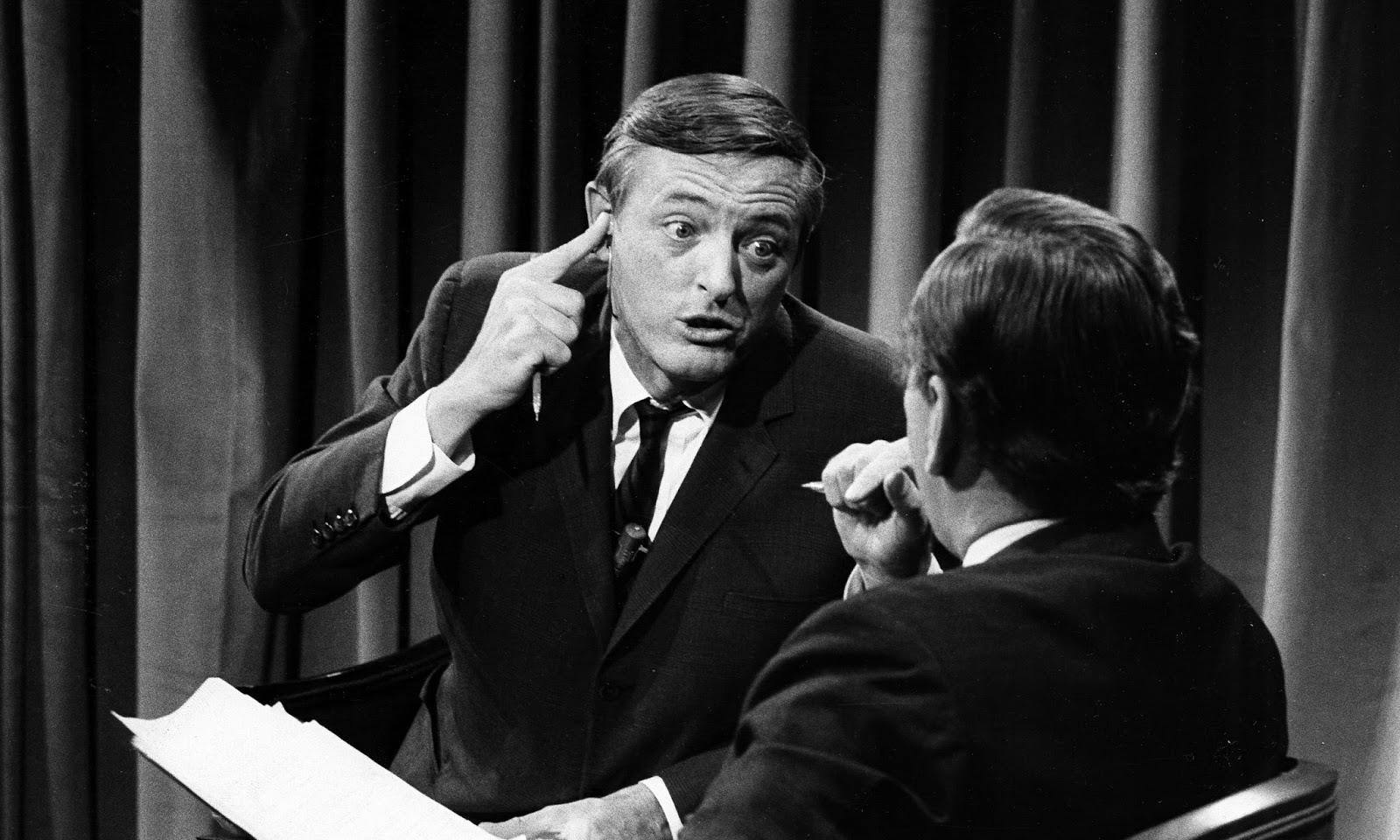
An animated William F. Buckley Jr. and Gore Vidal face off during one of their 10 debates for the 1968 Republican and Democratic National Conventions.

Best of Enemies chronicles early days of T.V. political punditry by re-telling story of the Buckley / Vidal 1968 slugfests


Robert Gordon and Morgan Neville's Best of Enemies brings to life the political debates between William F. Buckley Jr. and Gore Vidal that were held during the 1968 Republican National Convention in Miami, and the Democratic convention that followed the GOP's in Chicago.

Change of all kinds was in the air. It was the first time the conventions were broadcast in colour, and it marked the first time a major broadcaster broke from the 'gavel to gavel' convention coverage that U.S. networks had used in years past.

ABC was the network that instigated this change in a play for ratings, as ABC was lagging behind NBC and CBS. One of the talking heads in Best of Enemies says that if there had been four major networks, ABC would have taken fourth place.

Enter William F. Buckley and Gore Vidal.

ABC knew it wanted to hire Buckley as one of their commentators before the Republican convention. Buckley was the founding editor of National Review, a magazine that promotes conservative political positions and values. After serving in the United States Army during the Second World War, Buckley attended Yale, joined the Ivy League school's 'Skull and Bones' society. Post graduation he served in the CIA before going on to found National Review in 1955.

Asked by network head honchos who he would not debate, Buckley was able to come up with one name: Gore Vidal.

Vidal was in many ways Buckley's mirror image — also from the upper classes, he too served in the United States Army. Instead of pursuing an Ivy League education, Vidal became an author. His most memorable books include: The City and the Pillar (1948), The Judgment of Paris (1952), and Myra Breckinridge (1968). He was a close friend of the Kennedy family and involved in Democratic politics.

Both Buckley and Vidal unsuccessfully ran for elected office. Buckley for Mayor of New York City in 1965 and Vidal for Congress in 1960.

Before the debates Vidal hired a researcher to go through old issues of National Review and Buckley's past with a fine tooth comb for ammunition. Vidal also crowd tested jokes he would make at Buckley's expense with journalists. Buckley went sailing with friends for a week. As Historian Lee Edwards says, "I don't think (Vidal) was really interested in conducting a debate about the issues, or about the parties... what he wanted to do was expose Bill Buckley."

The filmmakers introduce clips from each of the 10 debates with the ring of a bell commonly used to start boxing matches. It fits because we see lots of sparring between Buckley and Vidal. From the start it's obvious Vidal is out for blood - personal attacks, catty remarks (Buckley aptly observes that Vidal has, "feline" qualities), nothing is off bounds for Gore.

It doesn't take much to see that Buckley believes in his Conservative positions. He thinks American society would benefit from adopting them. It's harder to see what Gore Vidal believes in, with the exception of taking Bill Buckley down. As Vidal says during one clip from the 1980s', "I am a happy warrior (when) I'm in battle and enjoying it."

Buckley and Vidal punch and counterpunch gamely. It's a treat to watch both men use their knowledge and education to try and one up each other. Your chances of seeing enemies like these two on television today are slim to none.

Segments of the 10 debates the filmmakers use highlight personal attacks more than any debates over policy. The Republican debates are relatively tame compared to what happens in Chicago.

At the Democratic National Convention there was rioting in the streets. Members of the Youth International 'Yippie' party were beaten and tear gassed by police. At one point, police lobbed tear gas into a downtown Chicago park at regular intervals throughout the day to keep protesters from using the park to demonstrate. Journalists inside the Hilton Hotel were even roughed up by the cops at one point.

Against this backdrop Buckley and Vidal's disagreements about how American society should be run intensified. The flash point came during an exchange on whether it was okay for protesters to use the Viet Cong flag.

Vidal: "The only pro or crypto-Nazi I can think of is yourself."

Buckley: "Now listen you queer, stop calling me a crypto-Nazi, or I'll sock you in your goddamn face and you'll stay plastered."

The aftermath of that moment lasted the rest of their lives — neither man could let it go.

On the last episode of William Buckley's talk show Firing Line, the tape was shown. Buckley says nothing, instead choosing to look at the floor. From one of Vidal's friends we learn that Gore would play the debate tapes again and again during his visits to La Rondinaia, Vidal's villa in Ravello, Italy.

In the months following the debates Buckley and Vidal published their respective accounts of what happened in Esquire magazine. There was a lawsuit and countersuit, which took years to resolve.

Although tame by today's standards, one of the documentary's talking heads suggests the Buckley / Vidal debates foreshadowed an unhappy future. I highly recommend Best of Enemies to anyone who loves a good documentary.