Showing posts with label Myra Breckinridge. Show all posts

Tuesday, September 8, 2015

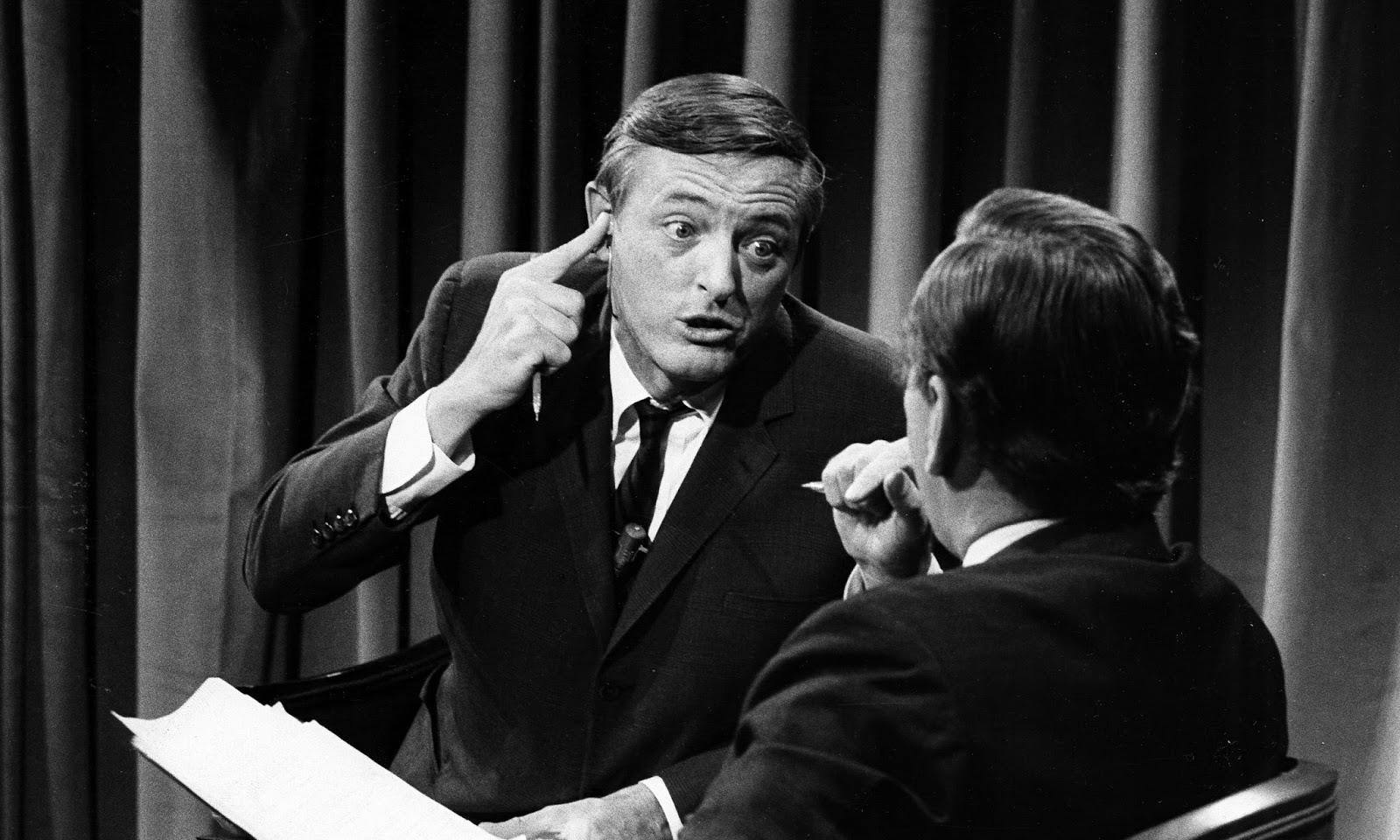
Best of Enemies: How William F. Buckley Jr. and Gore Vidal Changed T.V. News

An animated William F. Buckley Jr. and Gore Vidal face off during one of their 10 debates for the 1968 Republican and Democratic National Conventions.

Best of Enemies chronicles early days of T.V. political punditry by re-telling story of the Buckley / Vidal 1968 slugfests


Robert Gordon and Morgan Neville's Best of Enemies brings to life the political debates between William F. Buckley Jr. and Gore Vidal that were held during the 1968 Republican National Convention in Miami, and the Democratic convention that followed the GOP's in Chicago.

Change of all kinds was in the air. It was the first time the conventions were broadcast in colour, and it marked the first time a major broadcaster broke from the 'gavel to gavel' convention coverage that U.S. networks had used in years past.

ABC was the network that instigated this change in a play for ratings, as ABC was lagging behind NBC and CBS. One of the talking heads in Best of Enemies says that if there had been four major networks, ABC would have taken fourth place.

Enter William F. Buckley and Gore Vidal.

ABC knew it wanted to hire Buckley as one of their commentators before the Republican convention. Buckley was the founding editor of National Review, a magazine that promotes conservative political positions and values. After serving in the United States Army during the Second World War, Buckley attended Yale, joined the Ivy League school's 'Skull and Bones' society. Post graduation he served in the CIA before going on to found National Review in 1955.

Asked by network head honchos who he would not debate, Buckley was able to come up with one name: Gore Vidal.

Vidal was in many ways Buckley's mirror image — also from the upper classes, he too served in the United States Army. Instead of pursuing an Ivy League education, Vidal became an author. His most memorable books include: The City and the Pillar (1948), The Judgment of Paris (1952), and Myra Breckinridge (1968). He was a close friend of the Kennedy family and involved in Democratic politics.

Both Buckley and Vidal unsuccessfully ran for elected office. Buckley for Mayor of New York City in 1965 and Vidal for Congress in 1960.

Before the debates Vidal hired a researcher to go through old issues of National Review and Buckley's past with a fine tooth comb for ammunition. Vidal also crowd tested jokes he would make at Buckley's expense with journalists. Buckley went sailing with friends for a week. As Historian Lee Edwards says, "I don't think (Vidal) was really interested in conducting a debate about the issues, or about the parties... what he wanted to do was expose Bill Buckley."

The filmmakers introduce clips from each of the 10 debates with the ring of a bell commonly used to start boxing matches. It fits because we see lots of sparring between Buckley and Vidal. From the start it's obvious Vidal is out for blood - personal attacks, catty remarks (Buckley aptly observes that Vidal has, "feline" qualities), nothing is off bounds for Gore.

It doesn't take much to see that Buckley believes in his Conservative positions. He thinks American society would benefit from adopting them. It's harder to see what Gore Vidal believes in, with the exception of taking Bill Buckley down. As Vidal says during one clip from the 1980s', "I am a happy warrior (when) I'm in battle and enjoying it."

Buckley and Vidal punch and counterpunch gamely. It's a treat to watch both men use their knowledge and education to try and one up each other. Your chances of seeing enemies like these two on television today are slim to none.

Segments of the 10 debates the filmmakers use highlight personal attacks more than any debates over policy. The Republican debates are relatively tame compared to what happens in Chicago.

At the Democratic National Convention there was rioting in the streets. Members of the Youth International 'Yippie' party were beaten and tear gassed by police. At one point, police lobbed tear gas into a downtown Chicago park at regular intervals throughout the day to keep protesters from using the park to demonstrate. Journalists inside the Hilton Hotel were even roughed up by the cops at one point.

Against this backdrop Buckley and Vidal's disagreements about how American society should be run intensified. The flash point came during an exchange on whether it was okay for protesters to use the Viet Cong flag.

Vidal: "The only pro or crypto-Nazi I can think of is yourself."

Buckley: "Now listen you queer, stop calling me a crypto-Nazi, or I'll sock you in your goddamn face and you'll stay plastered."

The aftermath of that moment lasted the rest of their lives — neither man could let it go.

On the last episode of William Buckley's talk show Firing Line, the tape was shown. Buckley says nothing, instead choosing to look at the floor. From one of Vidal's friends we learn that Gore would play the debate tapes again and again during his visits to La Rondinaia, Vidal's villa in Ravello, Italy.

In the months following the debates Buckley and Vidal published their respective accounts of what happened in Esquire magazine. There was a lawsuit and countersuit, which took years to resolve.

Although tame by today's standards, one of the documentary's talking heads suggests the Buckley / Vidal debates foreshadowed an unhappy future. I highly recommend Best of Enemies to anyone who loves a good documentary.

Tuesday, January 7, 2014

Kids on TV, Will Munro's Army of Lovers & Myra Breckinridge

Kids on TV's final lineup. Left to Right: Roxanne Luchak, John Caffery, and Minus Smile

"That man is just a man. That man is just a ma-a-an..."
- Poison by Kids on TV from Pantheon (2013)

Those lyrics kick off Poison, the ninth track from Kids on TV's second, and sadly final, album. Released in December it's is a showcase of bouncy tracks made for dance floors (Dazzler, Haunted House of Rock, and Bobby among others). I was lucky to see the Kids perform a couple times during their 10 years together (2003-2013). The energy of those live stage shows was a treat to experience. John Caffery's bouncy stage presence is a wonder to behold - the man has moves.

News of the band's dissolution comes from an Xtra! article written by Keith Cole which, annoyingly, does not seem to be on the paper's website.

In Caffery's own words from an essay on Xtra!: "My band, Kids on TV, were honoured the first time we were asked by Will (Munro) to perform at (his Vazaleen party). I created Kids on TV after dancing at Vazaleen for three years because I was so inspired by the music I was surrounded by. The band was my response to experiencing the rock and roll high school that Vazaleen was for me. Although I worked at Vazaleen as a dancer, it was still a big deal for Kids on TV to be asked to play because the role had been filled by so many spectacular artists before, it felt like a real accomplishment for us."

I've been aware of Kids on TV for years; I even helped sell their first album Mixing Business with Pleasure (2007) when I volunteered at Toronto's Glad Day Bookshop. However, I was unaware of the punk sensation's origins. My winter break reading Army of Lovers: A Community History of Will Munro by Sarah Liss shed some light on the parties and happenings that inspired Caffery to create his band. Of even more interest, the book shines a spotlight on the late Will Munro. He was an artist, DJ, volunteer, entrepreneur, party promoter, and so much more. In the space of a decade he transformed T.O.'s nightlife scene by bringing queers from the city's various subcultures together under the big gay tent of his parties.

This was no small feat in a city known (perhaps unfairly) for its' cold, snobbish vibes. As Liss's book makes clear Munro was a bridge builder above all else who strove to create connections within Toronto's larger queer community. In the book Liss allows people who knew Munro to remember him in their own words. Army of Lovers was written in such a way to give the interviewees plenty of space to tell their stories. Here and there Liss steps in to provide context. Rather than interpreting the book for you here, I suggest buying a copy from Glad Day. You can also read an excerpt on The Grid's website here. Sarah Liss is The Grid's Culture Editor.

Her history of Munro is divided into three parts - his upbringing, the community work and parties, then a sad sequence concerned with Munro's brain cancer diagnosis and eventual death on May 21, 2010.

In life Munro was 'straight-edge' meaning he eschewed using drugs and alcohol. His peers' insights into this are revealing.

Alex McClelland: Will said he'd seen his brother get really drunk and be a jerk and an asshole. He (Will) did try to drink a few times, but I think what happened is he was scared that, if he drank, he would hit on the boys that he liked in Mississauga. He was never straight-edge for political reasons, I don't think. He was straight-edge because he was scared of losing control.

Further insights, often hilarious, are offered on Will's motivation to throw parties such as Vazaleen while dressed up in strange and wonderful costumes.

Alex McClelland: Will was obsessed with perverse costumes where he'd be invisible. He dressed up as a wolfman once, which he really liked. And there are pictures of him dressed like John Wayne Gacy in that disgusting outfit where he put clown makeup on and covered his face with nylons. He liked being a weird pervert in costumes that covered him up.

There are plenty of quotable jems like the above in Liss's book. McClelland has a treasure trove of them in part because of his status as one of Munro's former boyfriends and a close friend thereafter. It is this pervy counterculture spirit which is part of what made Will Munro a remarkable figure. In Toronto the Good he dared to be Bad in a loud way.

I identify with Munro because I am also an artist, though a painter where his primary mediums were sewing, poster design, and installations. There is also the fact that throughout the book the man's friends make reference to his cheapness, a trait I share. Long live Value Village!

***

In addition to Army of Lovers I also read Gore Vidal's Myra Breckinridge over the break. Published in 1968 it is quite possibly one of the first works of fiction with a transsexual protagonist. Chapter One begins with the once read never forgotten sentence: "I am Myra Breckinridge whom no man will ever possess. Clad only in garter belt and one dress shield, I held off the entire elite of the Trobriand Islanders, a race who possess no words for "why" or "because."

Myra Breckinridge is many things - a satire skewering gender politics and Hollywood, an account of the late 1960s' social climate as it manifested in California, and an insight into the author's encyclopedic knowledge of early Hollywood cinema. Even 45 years after its' publication the book still feels like a slap in the face. Told mostly through Myra's diary entries the tone is combative and informative simultaneously. Vidal takes the reader inside his protagonist's mind to make us understand her motivations. Even though he pulls this off Myra still comes across as one of the more unlikeable characters I've ever encountered. Out for money willed to her, she pursues the goal of obtaining her portion of an uncle's property with vengeful fury.

In 1974 the quick witted Vidal published Myron as a sequel. Printed in the wake of an anti-pornography ruling by the U.S. Supreme Court, Vidal substituted 'foul language' in the book with the names of the Justices involved in the legal decision.

***

A final note: If you're looking for a fun, light read this year with lots of sex and juicy gossip look no further than Joey Wargachuk's soon to be released Pixie Dust. The book is an autobiographical account of Toronto's queer club scene. Joey has seen it first hand as a host and poster designer for Club 120's popular Sodom event. He is running an Indiegogo campaign to raise funds to do a first printing and promote his book.

It's being published in April and I guarantee Pixie Dust will be one of the hottest titles to come from a local author this year. If you can spare some coin, help Joey turn his hard work into paperback reality.